
The story starts earlier than you think
We tend to talk about social mobility as if it starts when someone enters the workforce. First job, first salary, first chance to get a foot on the ladder. But the gap opens up much earlier than that.
Research from the University of St Andrews and Durham University tracked over 1 million children and found that girls receive 6.36% less monthly income from parents than boys from as early as age 6. By age 9, that gap has widened to nearly 11%. It takes girls almost a decade to reach income parity.
This isn’t about pocket money. It’s about practice. Managing money (deciding what to spend, what to save, what to prioritise) is a skill. And like any skill, it develops through doing. When children don’t get equal opportunities to practise, they don’t start from the same place.
The financial gap isn’t created in the workplace. It begins at home, in childhood, and compounds at every stage after that.
The story nobody told us
Our own Cost of Not Knowing research found that most people in the UK first learn about savings, credit and mortgages between the ages of 19 and 24, after the formal education window has largely closed. Only 9% learned about savings products before the age of 16 and fewer than 4% learned about borrowing, mortgages or investments.
And yet 78% of teachers report that their school delivers financial education. The problem is that 61% of young people don’t recall receiving any.
What fills that gap? For some, it’s parents and family. But what you learn at home depends entirely on what your family knows, what they’re willing to talk about, and what their own relationship with money looks like. It’s different for every family. That’s not a personal failing. It’s a structural one. Financial knowledge, like so many things, is unevenly inherited.
If what you know about money depends on the family you were born into, then financial knowledge becomes another thing that gets passed down rather than opened up.
The story behind the numbers
Here’s a number that tells it plainly. According to the Money and Pensions Service, 27% of UK adults could not pay an unexpected bill of £300 from spare money or affordable borrowing.
For more than a quarter of the country, a broken boiler, car repair or unexpected energy bill is enough to tip things over the edge.
The difference between financial resilience and financial crisis is, for many people, a savings buffer they were never taught to build.
The story that follows you
Here is where the data gets uncomfortable.
Our Cost of Not Knowing research asked a simple question: true or false, all debt negatively affects your credit score. The correct answer is false, as credit can actually improve your credit score when managed well. But across every group we surveyed, more people got it wrong than got it right.
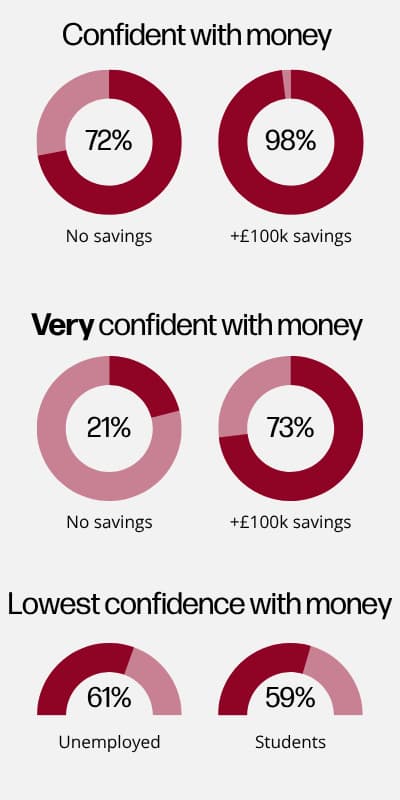
What makes this a social mobility story is what happens when you look at who is most affected. Confidence about money climbs steeply with savings: 72% net confidence among those with no savings, rising to 98% among those with £100,000 or more. The gap in those who feel very confident is even wider: 21% with no savings, versus 73% with £100,000 or more.
The pattern is also sharpest when you look at employment variables. People who are unemployed have the lowest net confidence of any working-age group at 61%, and only 23% correctly identified that not all debt harms your credit score. That is the lowest accurate response rate of any group we surveyed. Students sit at 59% net confidence, the lowest of all, with a third saying they simply don’t know the answer to the debt question.
These are two groups making some of the most consequential financial decisions of their lives. Both are doing it with the least confidence and the least reliable knowledge of any group we surveyed.
That’s not a coincidence. It’s what happens when financial education hasn’t included you. And this narrative follows you: into the job interview where you don’t negotiate your salary, into the credit agreement you don’t fully understand, into the retirement you never quite planned for.
A different story is possible
Our own data tells us that change is possible. In 2024/25, across 58,867 learners, 78% showed improved financial knowledge after our programmes and 70% reported increased confidence. Crucially, 49% of those learners had never previously received any financial education at all.
It’s not that people don’t want to understand money. It’s that the story of who financial education is for has been written too narrowly for too long. And when you grow up never seeing yourself in that story, you don’t just miss out on knowledge. You internalise the absence. You start to believe that being good with money is something other people are, not something you can become.
That’s the story we’re rewriting. One where the language of money isn’t a privilege of background. One where the question of who manages money well, who deserves it, who’s good with it has a much wider, more honest answer. This time, everyone’s in it.
We make money make sense. No matter where you started.
Sources: Money Ready, Cost of Not Knowing (2025) · Money and Pensions Service, MoneyView 2026 · Engels, Howard, Lukas and Philip (2024), Early Roots of Inequality, University of St Andrews/Durham University · Money Ready Impact Data 2024/25